Translating from English to Marathi is more than swapping words from one language for another. Marathi has its own grammar structure, honorifics, idioms, and cultural context that can trip up even fluent speakers.
Whether you’re a student, a business owner localizing content, or someone simply trying to message a Marathi-speaking friend correctly, this guide walks you through practical, tested English to Marathi translation tips that actually improve accuracy.
“A good translation doesn’t just carry words across a language it carries meaning, tone, and intent.”
By the end of this post, you’ll know the common mistakes to avoid, the best tools to use, and how to sound natural rather than robotic when translating English to Marathi.
Why English to Marathi Translation Is Tricky
English and Marathi belong to entirely different language families English is Germanic, while Marathi is an Indo-Aryan language written in the Devanagari script. This creates a few structural challenges:
- Word order differs. English follows Subject-Verb-Object (SVO), while Marathi typically follows Subject-Object-Verb (SOV).
- Gender and honorifics matter. Marathi nouns and verbs change based on gender (masculine, feminine, neuter), and respect levels (आपण vs तू) affect verb forms.
- Idioms rarely translate literally. A word-for-word English to Marathi translation of an idiom often sounds strange or means nothing at all.
- Script and pronunciation. Devanagari has sounds and conjunct letters that don’t exist in the Roman alphabet, so transliteration alone isn’t enough.
Understanding these differences is the first step toward better English to Marathi translation.
7 Practical Tips for Accurate English to Marathi Translation
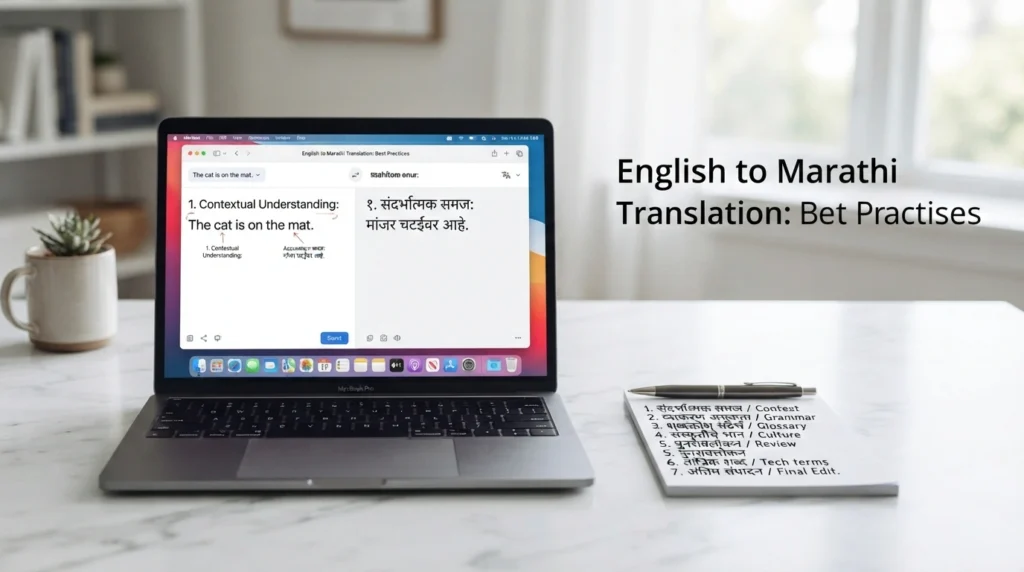
Understand Context Before You Translate
The same English word can have multiple Marathi equivalents depending on context. For example, “light” could mean उजेड (illumination), हलके (not heavy), or फिकट (a pale shade), depending on the sentence. Always read the full sentence not just the word before choosing a Marathi equivalent.
Learn Basic Marathi Grammar Rules
Marathi verbs change based on the subject’s gender and number. A sentence like “She is going” (ती जात आहे) differs from “He is going” (तो जात आहे) purely because of gender agreement. Skipping this rule is one of the most common English to Marathi translation mistakes.
Avoid Literal Word-for-Word Translation
Idiomatic English phrases like “break a leg” or “it’s raining cats and dogs” have no literal Marathi equivalent. Instead, find the Marathi expression that carries the same meaning, such as शुभेच्छा (good wishes) for “break a leg.”
Use Reliable Translation Tools But Verify Manually
Machine translation tools are useful for a first draft, but they often miss context and honorifics. Always have a native speaker or a fluent reviewer check the output before publishing or sending it.
Pay Attention to Formal vs Informal Tone
Marathi has distinct formal and informal registers. Business communication, government documents, and content for elders typically use आपण (aap), while casual conversations with friends use तू (tu). Choosing the wrong register can come across as rude or overly stiff.
Localize, Don’t Just Translate
Good English to Marathi translation adapts measurements, currency, dates, and cultural references so they make sense to a Marathi-speaking audience not just converts the language.
Read the Translation Aloud
Reading your Marathi translation aloud helps catch awkward phrasing that looks fine on paper but sounds unnatural when spoken. This is especially useful for scripts, dialogues, and marketing copy.
“Translation is not a matter of words only: it is a matter of making intelligible a whole culture.”
Common Mistakes to Avoid in English to Marathi Translation
Here’s a quick listicle of pitfalls that even experienced translators fall into:
- Ignoring gender agreement in verbs and adjectives.
- Over-relying on machine translation without human review.
- Translating idioms literally, producing confusing or comical results.
- Mixing formal and informal tone within the same piece of content.
- Using outdated or regional slang that doesn’t match the target audience.
- Skipping proofreading, which allows small grammar errors to slip through.
- Neglecting script accuracy, such as incorrect conjunct letters in Devanagari.
Best Tools for English to Marathi Translation
Free Online Tools
Free tools are great for quick, low-stakes translations everyday messages, short phrases, or getting the gist of a sentence.
Professional Translation Services
For legal documents, business contracts, or published content, professional human translators or certified agencies ensure accuracy and cultural appropriateness that automated tools can’t fully guarantee.
Bilingual Dictionaries and Grammar Guides
Keeping a Marathi grammar reference handy helps you double-check verb conjugations and gendered nouns, which are the most common source of English to Marathi translation errors.
Frequently Asked Questions (FAQs)
Is English to Marathi translation the same as transliteration?
No. Transliteration converts English letters into Devanagari script phonetically, while translation converts the actual meaning of the words. Transliteration doesn’t guarantee correct grammar or meaning.
What is the biggest challenge in English to Marathi translation?
The biggest challenge is usually gender agreement and word order, since Marathi grammar rules differ significantly from English.
Can I fully trust machine translation for Marathi?
Machine translation is improving rapidly and works well for simple sentences, but it still struggles with idioms, tone, and context. Human review is recommended for anything formal or public-facing.
How can I improve my English to Marathi translation skills?
Practice regularly, read Marathi literature or news, learn grammar rules systematically, and get feedback from native speakers.
Are there different dialects of Marathi that affect translation?
Yes. Marathi has regional variations (such as Varhadi, Ahirani, and Konkani-influenced dialects), though standard Marathi used in media and formal writing is understood across Maharashtra.
Conclusion
Mastering English to Marathi translation takes more than a dictionary it requires understanding grammar, tone, cultural context, and the nuances that make language feel natural rather than mechanical.
By applying the tips above and cross-checking with reliable tools or native speakers, you’ll produce translations that are accurate, respectful, and easy to understand.
References
- Wikipedia contributors. “Marathi language.” Wikipedia, The Free Encyclopedia.
- Britannica, “Marathi language,” Encyclopaedia Britannica.
- Central Institute of Indian Languages (CIIL), Government of India — resources on Marathi grammar and linguistics.
- Google Translate — Marathi language documentation and usage notes.